
The culture of Saudi Arabia is a rich one that has been shaped by its Islamic heritage, its historical role as an ancient trade center, and its Bedouin traditions. Saudi society has experienced tremendous development over the past several decades, and the Saudi people have taken their values and traditions and adapted them to the modern world. The Crossroads of the World Located at the center of important ancient trade routes, the Arab people were enriched by many different civilizations. As early as 3000 BC, Arab merchants were part of a far-reaching trade network that extended to south Asia, the Mediterranean and Egypt. They served as a vital link between India and the Far East on one side, and Byzantium and the Mediterranean lands on the other.
The introduction of Islam in the 7th century AD further defined the region’s culture. Within a century of its birth in the Arabian Peninsula, Islam had spread west to the Atlantic Ocean and east to India and China. It fostered a dynamic period of great learning in culture, science, philosophy and the arts known as the Islamic ‘‘Golden Age.’’ Every year for the past 14 centuries, Muslim pilgrims from around the world have traveled to holy sites in Makkah and Madinah, further enriching the region’s culture. The pilgrims brought ivory from Africa and carpets from the East, and took local goods back to their homelands.
When the Kingdom of Saudi Arabia was formed in 1932, King Abdulaziz bin Abdulrahman Al-Saud dedicated himself to preserving Arab and Islamic traditions and culture, and his sons and successors have done the same. Arab and Islamic Traditions Saudi traditions are rooted in Islamic teachings and Arab customs, which Saudis learn about at an early age from their families and in schools. The highlights of the year are the holy month of Ramadan and the Hajj (pilgrimage) season, and the holidays that follow them. The holy month of Ramadan, during which Muslim fast from dawn to dusk, culminates with teh Eid-Al-Fitr, in which it is customary to buy presents and clothes for children and visit friends and relatives.
Cultural Do’s and Don’ts:
• It is insulting to ask about a Muslim’s wife or another female family member.
• Don’t stare at women on the street or initiate conversation with them.
• If meeting a female, do not attempt to shake her hand unless she extends it. In addition, never greet a woman with an embrace or kiss.
• Avoid pointing a finger at an Arab or beckoning with a finger.
• Use the right hand to eat, touch, and present gifts; the left is generally regarded as unclean.
• Avoid putting feet on tables or furniture.
• Refrain from leaning against walls, slouching in chairs, and keeping hands in pockets.
• Do not show the soles of the feet, as they are the lowest and dirtiest part of the body.
(credits to https://lostinriyadh.wordpress.com/)
Showing posts with label Saudi Arabia. Show all posts
Showing posts with label Saudi Arabia. Show all posts
Thursday, April 28, 2016

Tuesday, April 26, 2016
Saudi Arabia part 3
Assalamualaikum guys. Welcome back. :)
So what are we going to write in this entry? Have any ideas? Nope? heee
We are going to write on the clothing of Saudis people.
CLOTHING
Headwear: Arab men often wear a three-piece head cover. The bottom piece of this head covering is a white cap that is sometimes filled with holes. This cap, called keffiya, is used to hold the hair in place. On top of it is a square cloth called a ghutra. On top of it is the agal, which is a thick, black cord woven into two rings that surrounds the top of the head and holds everything else in place. For male children, wearing the head covering is a sign of entering manhood. Inside the house, the head covering is not needed, although when a man has guests in his house he often wears it as a sign of respect. A checked ghutra is a symbol of a region. The agal cord is a holdover from the days when nomadic Saudis used the cords to tether their camels, and then wrapped the cord around their heads when riding to keep their ghutra in place. When this headwear is forcibly removed, one’s honor is tainted and blood has to be shed to remove the shame. But if the agal is removed voluntarily, the wearer is signifying allegiance. Arab women typically wear a scarf-like cover called Hejab that covers the hair but not the face.
Garments: Traditional Saudi male attire consists of a long-sleeved, one piece dress—called a dishdashah—that covers the whole body. This garment allows the air to circulate, which helps cool the body. During summer, it is usually made of white cotton; in winter, it is made from heavier fabric such as wool, and comes in darker colors. Dress is a major mark of identity in Saudi Arabia. Saudis (and other Gulf Arabs) wear a distinctive dishdashah or abaya. Foreign workers wear either their native clothing or westernstyle dress. Among male foreigners, the use of non-European style clothes is associated with low-paid, unskilled labor. South Asian women wear brightly colored saris or Western-style clothes. Saudi women in public in Saudi Arabia must be covered from head to toe in a black, anklelength, undecorated abaya and head scarf (hejab). The mutawwa, or religious police, will chase and beat women with camel whips if they spot a woman’s bare skin—occasionally an ankle or a wrist—in public. Unlike Arab women, however, South Asian women tend not to wear an abaya or hejab. Many Indian women wear a pin on their nose studded with semi-precious stones. Once a symbol of purity and marriage, the nose pin is today worn by many unmarried girls as well.
Done reading on their clothings? Don't worry, we have one more to share with you in this entry.
Lifestyle
Role of Family: A Saudi sees himself in the context of his family and, to a lesser degree, the tribe. His duty is never to himself but to the group. Within the family there is a strong sense of patrilineal descent, because a man is considered to be a descendant only of his father and paternal grandfather, never of his mother and or maternal grandfather. He belongs only to his father’s group, which claims his undivided loyalty. The most sought after marriages are first cousin marriages between children of brothers because by sharing the same grandfather, group solidarity is ensured. Saudis live in large extended families, a legacy of the nomadic lifestyle of their predecessors who travelled around the desert in family and tribal groups. The extended family functions as an economic unit. There is a distinct hierarchy in the Saudi family, made up of the male members of the family in descending order of age. The oldest male member decides what is in the best interests of the family, and the other family members are expected to agree and obey. The concept and practice of the intense individualism of the West is foreign to the Saudis. The lack of independent choice, even in matters of higher education, marriage and occupation, is accepted because the family is seen as a refuge that must remain unified to defend itself against the outside world. Similar to the tribal nomadic way of life that relied on the family for defense, modern Saudi families are a support system and safety net for the individual.
(credits to https://lostinriyadh.wordpress.com/ )
Thanks for reading guys. We'll update you guys more on the next entry. Thank you. :)XOXO
So what are we going to write in this entry? Have any ideas? Nope? heee
We are going to write on the clothing of Saudis people.
CLOTHING
Headwear: Arab men often wear a three-piece head cover. The bottom piece of this head covering is a white cap that is sometimes filled with holes. This cap, called keffiya, is used to hold the hair in place. On top of it is a square cloth called a ghutra. On top of it is the agal, which is a thick, black cord woven into two rings that surrounds the top of the head and holds everything else in place. For male children, wearing the head covering is a sign of entering manhood. Inside the house, the head covering is not needed, although when a man has guests in his house he often wears it as a sign of respect. A checked ghutra is a symbol of a region. The agal cord is a holdover from the days when nomadic Saudis used the cords to tether their camels, and then wrapped the cord around their heads when riding to keep their ghutra in place. When this headwear is forcibly removed, one’s honor is tainted and blood has to be shed to remove the shame. But if the agal is removed voluntarily, the wearer is signifying allegiance. Arab women typically wear a scarf-like cover called Hejab that covers the hair but not the face.
Garments: Traditional Saudi male attire consists of a long-sleeved, one piece dress—called a dishdashah—that covers the whole body. This garment allows the air to circulate, which helps cool the body. During summer, it is usually made of white cotton; in winter, it is made from heavier fabric such as wool, and comes in darker colors. Dress is a major mark of identity in Saudi Arabia. Saudis (and other Gulf Arabs) wear a distinctive dishdashah or abaya. Foreign workers wear either their native clothing or westernstyle dress. Among male foreigners, the use of non-European style clothes is associated with low-paid, unskilled labor. South Asian women wear brightly colored saris or Western-style clothes. Saudi women in public in Saudi Arabia must be covered from head to toe in a black, anklelength, undecorated abaya and head scarf (hejab). The mutawwa, or religious police, will chase and beat women with camel whips if they spot a woman’s bare skin—occasionally an ankle or a wrist—in public. Unlike Arab women, however, South Asian women tend not to wear an abaya or hejab. Many Indian women wear a pin on their nose studded with semi-precious stones. Once a symbol of purity and marriage, the nose pin is today worn by many unmarried girls as well.
Done reading on their clothings? Don't worry, we have one more to share with you in this entry.
Lifestyle
Role of Family: A Saudi sees himself in the context of his family and, to a lesser degree, the tribe. His duty is never to himself but to the group. Within the family there is a strong sense of patrilineal descent, because a man is considered to be a descendant only of his father and paternal grandfather, never of his mother and or maternal grandfather. He belongs only to his father’s group, which claims his undivided loyalty. The most sought after marriages are first cousin marriages between children of brothers because by sharing the same grandfather, group solidarity is ensured. Saudis live in large extended families, a legacy of the nomadic lifestyle of their predecessors who travelled around the desert in family and tribal groups. The extended family functions as an economic unit. There is a distinct hierarchy in the Saudi family, made up of the male members of the family in descending order of age. The oldest male member decides what is in the best interests of the family, and the other family members are expected to agree and obey. The concept and practice of the intense individualism of the West is foreign to the Saudis. The lack of independent choice, even in matters of higher education, marriage and occupation, is accepted because the family is seen as a refuge that must remain unified to defend itself against the outside world. Similar to the tribal nomadic way of life that relied on the family for defense, modern Saudi families are a support system and safety net for the individual.
(credits to https://lostinriyadh.wordpress.com/ )
Thanks for reading guys. We'll update you guys more on the next entry. Thank you. :)
Thursday, April 14, 2016
Saudi Arabia part 2
Assalamualaikum and have a nice day guys. :)
Let's continue with the next entry on Saudi Arabia.
Diet
The Saudi diet varies by lifestyle. A farmer consumes different foods than a nomad, and a city dweller may eat traditional Saudi cuisine as well as Western food. A staple of the Saudi diet, regardless of lifestyle, is dates. They are eaten either raw or cooked, and come in red and black varieties. The diet of a farmer is based on grains, such as millet, rice, barley and wheat. Fruit and dates are eaten regularly. Lamb is the most commonly consumed meat, occasionally supplemented by goat and camel meat. The nomadic diet depends on milk products from goats, sheep or camels. Milk is consumed fresh or made into yogurt and cheese. Meat is only eaten on special occasions or when wild game is available. When nomads visit a town they purchase fruits and vegetables to eat. The main meal for nomads is at the end of the day, accompanied by coffee and tea. Saudis who live in towns and cities have a variety of foods available to them. A typical Saudi meal consists of rice with spiced chicken or lamb, or kebabs, with dates, and dairy products. The meal is accompanied by flatbread. Commonly prepared dishes are tabbouleh, a salad made with bulgar (cracked) wheat and mint; hummus, a dip made from chick peas; mutabak, pastry turnovers stuffed with cheese, banana or meat; salig, lamb cooked in a mild spiced sauce and served with rice; mihammar, stuffed lamb in a yogurt sauce; kabbza, lamb or chicken with onion, tomato, cucumber and grated carrot; thurid, chicken in a cream sauce served on leaves of dough; sambustik, triangles of dough filled with spicy meat and onion and then fried in oil.
Coffee is offered at every social gathering, business meeting and meal. To accept less than three cups of coffee is considered impolite. To indicate that one is done, wobble the cup before giving it back to the host. Food and beverages cannot be consumed in public during the holy month of Ramadan, even by non-Muslims.
The South Asian diet includes biryanis (rice with saffron, meat, fish, or chicken), dhal (a lentilbased soup), and several types of bread. Cows are sacred to Hindus; chicken and lamb are the most commonly consumed meats. The Bangladeshi and Sri Lankan diets contain more rice and fish than the Indian and Pakistani diets.
Etiquette and Customs in Saudi
Meeting Etiquette
- Men shake hands. Good friends may greet each other with a handshake and a kiss on each cheek.
- Women generally hug and kiss close friends.
- Men and women would not greet each other in public I from outside the family.
- When Saudis greet each other they take their time and converse about general things.
Gift Giving Etiquette
- Gifts are not the norm as in many other countries.
- If you are invited to a Saudi's house bring something small as a thank you.
- Flowers do not make good gifts from a man, although a woman could give them to her hostess.
- Never give alcohol unless you are positive they partake.
- Gifts are not opened when received.
Dining Etiquette
- Saudis socialize primarily in restaurants and international hotels when entertaining expatriates whom they do not know well. After some time you will be invited to the home.
- Entertainment will generally be same-sex only. If both sexes are included, they will be in separate rooms.
- If you are invited to a Saudi's house, you would usually remove your shoes.
- Dress conservatively.
- Try to arrive at the invited time. Punctuality is appreciated but not crucial.
- Show respect for the elders by greeting them first.
- Accept the offer of Arabian coffee and dates even if you do not normally drink coffee.
- If you are invited for a meal, understand that there will be a great deal of socializing and small talk before the meal is served.
Table manner
- If the meal is on the floor, sit cross-legged or kneel on one knee.
- Eat only with the right hand as the left is considered unclean.
- Try a bit of everything that is served.
- Meals are generally served family-style.
- Honoured guests are often offered the most prized pieces such as a sheep's head so be prepared!
- There is often more food than you can eat. Part of Saudi hospitality and generosity is to shower guests with abundance.
- There is little conversation during meals so that diners may relish the food.
(credits to https://lostinriyadh.wordpress.com/ )
Let's continue with the next entry on Saudi Arabia.
Diet
The Saudi diet varies by lifestyle. A farmer consumes different foods than a nomad, and a city dweller may eat traditional Saudi cuisine as well as Western food. A staple of the Saudi diet, regardless of lifestyle, is dates. They are eaten either raw or cooked, and come in red and black varieties. The diet of a farmer is based on grains, such as millet, rice, barley and wheat. Fruit and dates are eaten regularly. Lamb is the most commonly consumed meat, occasionally supplemented by goat and camel meat. The nomadic diet depends on milk products from goats, sheep or camels. Milk is consumed fresh or made into yogurt and cheese. Meat is only eaten on special occasions or when wild game is available. When nomads visit a town they purchase fruits and vegetables to eat. The main meal for nomads is at the end of the day, accompanied by coffee and tea. Saudis who live in towns and cities have a variety of foods available to them. A typical Saudi meal consists of rice with spiced chicken or lamb, or kebabs, with dates, and dairy products. The meal is accompanied by flatbread. Commonly prepared dishes are tabbouleh, a salad made with bulgar (cracked) wheat and mint; hummus, a dip made from chick peas; mutabak, pastry turnovers stuffed with cheese, banana or meat; salig, lamb cooked in a mild spiced sauce and served with rice; mihammar, stuffed lamb in a yogurt sauce; kabbza, lamb or chicken with onion, tomato, cucumber and grated carrot; thurid, chicken in a cream sauce served on leaves of dough; sambustik, triangles of dough filled with spicy meat and onion and then fried in oil.
Coffee is offered at every social gathering, business meeting and meal. To accept less than three cups of coffee is considered impolite. To indicate that one is done, wobble the cup before giving it back to the host. Food and beverages cannot be consumed in public during the holy month of Ramadan, even by non-Muslims.
The South Asian diet includes biryanis (rice with saffron, meat, fish, or chicken), dhal (a lentilbased soup), and several types of bread. Cows are sacred to Hindus; chicken and lamb are the most commonly consumed meats. The Bangladeshi and Sri Lankan diets contain more rice and fish than the Indian and Pakistani diets.
Etiquette and Customs in Saudi
Meeting Etiquette
- Men shake hands. Good friends may greet each other with a handshake and a kiss on each cheek.
- Women generally hug and kiss close friends.
- Men and women would not greet each other in public I from outside the family.
- When Saudis greet each other they take their time and converse about general things.
Gift Giving Etiquette
- Gifts are not the norm as in many other countries.
- If you are invited to a Saudi's house bring something small as a thank you.
- Flowers do not make good gifts from a man, although a woman could give them to her hostess.
- Never give alcohol unless you are positive they partake.
- Gifts are not opened when received.
Dining Etiquette
- Saudis socialize primarily in restaurants and international hotels when entertaining expatriates whom they do not know well. After some time you will be invited to the home.
- Entertainment will generally be same-sex only. If both sexes are included, they will be in separate rooms.
- If you are invited to a Saudi's house, you would usually remove your shoes.
- Dress conservatively.
- Try to arrive at the invited time. Punctuality is appreciated but not crucial.
- Show respect for the elders by greeting them first.
- Accept the offer of Arabian coffee and dates even if you do not normally drink coffee.
- If you are invited for a meal, understand that there will be a great deal of socializing and small talk before the meal is served.
Table manner
- If the meal is on the floor, sit cross-legged or kneel on one knee.
- Eat only with the right hand as the left is considered unclean.
- Try a bit of everything that is served.
- Meals are generally served family-style.
- Honoured guests are often offered the most prized pieces such as a sheep's head so be prepared!
- There is often more food than you can eat. Part of Saudi hospitality and generosity is to shower guests with abundance.
- There is little conversation during meals so that diners may relish the food.
(credits to https://lostinriyadh.wordpress.com/ )
Friday, March 25, 2016
Saudi Arabia part 1
Assalamualaikum and welcome back. :)
let us start with the history of Saudi Arabia.
Saudi Arabs grew out of the larger group of nomadic inhabitants of the Arabian peninsula, who were known as “Arab.” The prophet Muhammad briefly unified the Arabs of the Arabian peninsula at the beginning of the Islamic religion in the 7th Century, but this unity was short-lived as the newly established Arab empire migrated north into Iraq, where the Abbasid Caliphate was established. The term “Arab” is now largely a cultural/linguistic designation, embracing various national, regional, and religious groups in several different countries.
The inhabitants of the Arabian Peninsula lacked a common cultural and ethnic identity until the 18th Century when Abd al-Wahhab and Muhammad Ibn Saud sought to unify the peninsula based on their shared religious-political philosophy. Al-Wahhab was a religious scholar who objected to what he called deviations from strict Islamic teachings and practices. Al-Wahhab advocated a return to the original Islam as practiced at the time of the prophet Muhammad in the 7th Century. Al-Wahhab reinforced the notion that the Saudi Arab identity is closely tied to the early events of Islam, which occurred on Saudi territory in the Hijaz in the 8th Century A.D.
FACTS AND STATISTICS OF SAUDI ARABIA
Official name: Al-Mamlakah al-ʿArabiyyah al-Suʿūdiyyah (Kingdom of Saudi Arabia)
Form of government: Monarchy
Head of state and government: King: Salman bin Abdulaziz Al Saud
Capital: Riyadh
Official language: Arabic
Official religion: Islam
Monetary unit: Saudi riyal (SR)
Population: (2014 est.) 30,955,000
Total area (sq mi): 830,000
Total area (sq km): 2,149,690
Urban-rural population Urban: (2012) 82.5%
Rural: (2012) 17.5%
Life expectancy at birth: Male- (2011) 73 years
Female- (2011) 75.2 years
Literacy (percentage of population age 15 and over literate): Male- (2008) 89.5%
Female- (2008) 80.2%
GNI per capita (U.S.$): (2013) 26,200
 (the picture of King Salman bin Abdulaziz Al Saud)
King Salman bin Abdulaziz acceded to the throne after the death of King Abdullah on January 23, 2015. He was designated Crown Prince, and appointed Deputy Prime Minister, by Custodian of the Two Holy Mosques King Abdullah bin Abdulaziz on June 18, 2012, upon the death of Crown Prince Nayef bin Abdulaziz. As Crown Prince, King Salman also serves as Minister of Defense.
King Salman was born in Riyadh on Dec. 31, 1935, and received his education at the Prince’s School in Riyadh. He served as Deputy Governor of Riyadh from March 1954 to April 1955, and Governor of Riyadh from April 1955 to December 1960 and again from February 1963 to Nov. 5, 2011, when he was appointed Minister of Defense.
Since 1956, King Salman has chaired various humanitarian and service committees that provide relief from natural and man-made disasters. For his humanitarian services, he has been awarded many medals and decorations, including awards from Bahrain, Bosnia and Herzegovina, France, Morocco, Palestine, the Philippines, Senegal, the United Nations, Yemen, and the King Abdulaziz Medal - First Class.
He is a recipient of several honorary degrees and academic awards, including an honorary doctorate from the Islamic University of Madinah, the King Salman academic award, and the Kant Medal by the Berlin-Brandenburg Academy of Sciences and Humanities in appreciation of his contributions to the field of science.
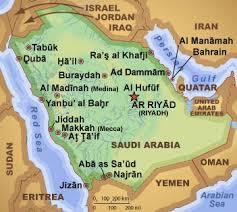
Maps of Saudi Arabia
We'll continue on this topic in the next entry. Till next time guys. :)
xoxo
let us start with the history of Saudi Arabia.
Saudi Arabs grew out of the larger group of nomadic inhabitants of the Arabian peninsula, who were known as “Arab.” The prophet Muhammad briefly unified the Arabs of the Arabian peninsula at the beginning of the Islamic religion in the 7th Century, but this unity was short-lived as the newly established Arab empire migrated north into Iraq, where the Abbasid Caliphate was established. The term “Arab” is now largely a cultural/linguistic designation, embracing various national, regional, and religious groups in several different countries.
The inhabitants of the Arabian Peninsula lacked a common cultural and ethnic identity until the 18th Century when Abd al-Wahhab and Muhammad Ibn Saud sought to unify the peninsula based on their shared religious-political philosophy. Al-Wahhab was a religious scholar who objected to what he called deviations from strict Islamic teachings and practices. Al-Wahhab advocated a return to the original Islam as practiced at the time of the prophet Muhammad in the 7th Century. Al-Wahhab reinforced the notion that the Saudi Arab identity is closely tied to the early events of Islam, which occurred on Saudi territory in the Hijaz in the 8th Century A.D.
FACTS AND STATISTICS OF SAUDI ARABIA
Official name: Al-Mamlakah al-ʿArabiyyah al-Suʿūdiyyah (Kingdom of Saudi Arabia)
Form of government: Monarchy
Head of state and government: King: Salman bin Abdulaziz Al Saud
Capital: Riyadh
Official language: Arabic
Official religion: Islam
Monetary unit: Saudi riyal (SR)
Population: (2014 est.) 30,955,000
Total area (sq mi): 830,000
Total area (sq km): 2,149,690
Urban-rural population Urban: (2012) 82.5%
Rural: (2012) 17.5%
Life expectancy at birth: Male- (2011) 73 years
Female- (2011) 75.2 years
Literacy (percentage of population age 15 and over literate): Male- (2008) 89.5%
Female- (2008) 80.2%
GNI per capita (U.S.$): (2013) 26,200

King Salman bin Abdulaziz acceded to the throne after the death of King Abdullah on January 23, 2015. He was designated Crown Prince, and appointed Deputy Prime Minister, by Custodian of the Two Holy Mosques King Abdullah bin Abdulaziz on June 18, 2012, upon the death of Crown Prince Nayef bin Abdulaziz. As Crown Prince, King Salman also serves as Minister of Defense.
King Salman was born in Riyadh on Dec. 31, 1935, and received his education at the Prince’s School in Riyadh. He served as Deputy Governor of Riyadh from March 1954 to April 1955, and Governor of Riyadh from April 1955 to December 1960 and again from February 1963 to Nov. 5, 2011, when he was appointed Minister of Defense.
Since 1956, King Salman has chaired various humanitarian and service committees that provide relief from natural and man-made disasters. For his humanitarian services, he has been awarded many medals and decorations, including awards from Bahrain, Bosnia and Herzegovina, France, Morocco, Palestine, the Philippines, Senegal, the United Nations, Yemen, and the King Abdulaziz Medal - First Class.
He is a recipient of several honorary degrees and academic awards, including an honorary doctorate from the Islamic University of Madinah, the King Salman academic award, and the Kant Medal by the Berlin-Brandenburg Academy of Sciences and Humanities in appreciation of his contributions to the field of science.
Maps of Saudi Arabia
We'll continue on this topic in the next entry. Till next time guys. :)
xoxo
Wednesday, March 2, 2016
Get to know others.
Assalamualaikum people. hyeee.. :)
We're sorry for the late of posting information on this blog. busy girls, you know.. hehe :P
so before we start on posting about what we need to share with u guys, let us see these flags first.
 any of u know about this flag? yes? no? who mentioned Saudi? YES!! this is Saudi Arabia's flag. so clever ;)
 hikss
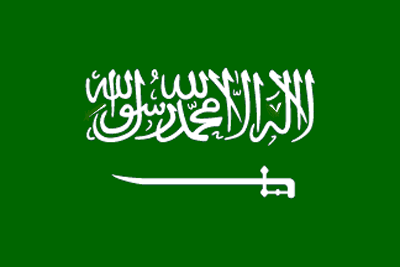
Description on Saudi's flag :
The flag of Saudi Arabia was officially adopted in 1973.
Saudi Arabia's flag uses green to honor the country's puritanical Muslim Wahabi sect, and also because green is widely believed to be the prophet Muhammad's favorite color. The white, centered script, the shahada, is the Muslim Statement of Faith, "There is no God but God, and Muhammad is the Messenger of God". The sword represents Abd-al-Aziz.
(taken from http://www.worldatlas.com/webimage/flags/countrys/mideast/saudiarb.htm )
We have three topics which are Saudi Arabia country as out main topic, Myanmar as topic under race and the third is Baba Nyonya ethnic. So now we know about the flag of Saudi Arabia country. Let us see the second flag.
Any idea which flag is this? this flag belongs to Myanmar or also known as Burma.
Myanmar Flag - Introduction Myanmar flag has three equal horizontal stripes of yellow (top), green, and red; centered on the green band is a large white five-pointed star that partially overlaps onto the adjacent colored stripes; the design revives the triband colors used by Burma from 1943-45, during the Japanese occupation.
The history on this flag: Republic of the Union of Myanmar officially unveiled the current flag at 3pm on 21 October 2010 to replace the former flag in use since 1974. (The old flag, introduced by the socialist government of Ne Win in 1974, has a red field with a blue rectangle in the left corner bearing a cog wheel and a rice plant encircled by 14 stars representing the country's seven regions and seven states).

The old flags were lowered by government officials who were born on a Tuesday, while the new flags were raised by officials born on a Wednesday. The date and peculiar timing suggested the influence numerology. The date was 21 -- 2 plus 1 equals 3 -- the time was 3:00 and the year was 2010, whose digits add up to three. Added together they equal nine, an auspicious number in Myanmar. (In the 1980s, the nation had bank notes in denominations of 45 and 90 kyats, because each of those two numbers add up to nine!) The new flag was introduced as part of the changes to national symbols that were laid out in the 2008 Constitution pushed by the military junta.
(taken from http://myanmarflag.facts.co/myanmarflagof/myanmarflag.php )
Long history aitee :)
So next let us see the next topic which is about Baba Nyonya community or known as 'Peranakans'. But for this third topic wont have any specific flag, as they are one of the race that may stay in Singapore, Indonesia and Malaysia, specifically in Melaka and Penang.

(the photo of Baba Nyonya woman)
So that's all for all guys. See u in our next post. bubyee... :)
Description on Saudi's flag :
The flag of Saudi Arabia was officially adopted in 1973.
Saudi Arabia's flag uses green to honor the country's puritanical Muslim Wahabi sect, and also because green is widely believed to be the prophet Muhammad's favorite color. The white, centered script, the shahada, is the Muslim Statement of Faith, "There is no God but God, and Muhammad is the Messenger of God". The sword represents Abd-al-Aziz.
(taken from http://www.worldatlas.com/webimage/flags/countrys/mideast/saudiarb.htm )
We have three topics which are Saudi Arabia country as out main topic, Myanmar as topic under race and the third is Baba Nyonya ethnic. So now we know about the flag of Saudi Arabia country. Let us see the second flag.

Any idea which flag is this? this flag belongs to Myanmar or also known as Burma.
Myanmar Flag - Introduction Myanmar flag has three equal horizontal stripes of yellow (top), green, and red; centered on the green band is a large white five-pointed star that partially overlaps onto the adjacent colored stripes; the design revives the triband colors used by Burma from 1943-45, during the Japanese occupation.
The history on this flag: Republic of the Union of Myanmar officially unveiled the current flag at 3pm on 21 October 2010 to replace the former flag in use since 1974. (The old flag, introduced by the socialist government of Ne Win in 1974, has a red field with a blue rectangle in the left corner bearing a cog wheel and a rice plant encircled by 14 stars representing the country's seven regions and seven states).

The old flags were lowered by government officials who were born on a Tuesday, while the new flags were raised by officials born on a Wednesday. The date and peculiar timing suggested the influence numerology. The date was 21 -- 2 plus 1 equals 3 -- the time was 3:00 and the year was 2010, whose digits add up to three. Added together they equal nine, an auspicious number in Myanmar. (In the 1980s, the nation had bank notes in denominations of 45 and 90 kyats, because each of those two numbers add up to nine!) The new flag was introduced as part of the changes to national symbols that were laid out in the 2008 Constitution pushed by the military junta.
(taken from http://myanmarflag.facts.co/myanmarflagof/myanmarflag.php )
Long history aitee :)
So next let us see the next topic which is about Baba Nyonya community or known as 'Peranakans'. But for this third topic wont have any specific flag, as they are one of the race that may stay in Singapore, Indonesia and Malaysia, specifically in Melaka and Penang.
(the photo of Baba Nyonya woman)
So that's all for all guys. See u in our next post. bubyee... :)
Subscribe to:
Posts (Atom)


