Assalamualaikum and welcome back awesome people ;)
We are going to share on the wedding of the Peranakans. Read up guys.
It was not uncommon for early Chinese traders to take Malay women of Peninsular Malay or Sumatera as wives or concubines. Consequently the Baba Nyonya possessed a synergistic mix of Sino-Malay cultural traits. Written records from the 19th and early 20th centuries show that Peranakan men usually took brides from within the local Peranakan community. Peranakan families occasionally imported brides from China and sent their daughters to China to find husbands.
Marriages within the community and of similar stature were the norm. Wealthy men prefigured to marry a chin choay: or matrilocal marriage where husband moved in with wife's family.
Proposals of marriage were made by a gift of a pinangan, a 2-tiered lacquered basket, to the intended bride's parents brought by a go-between who speaks on behalf of the suitor. Most Peranakans are not Muslim, and have retained the traditions of ancestor worship of the Chinese, though some converted to Christianity.
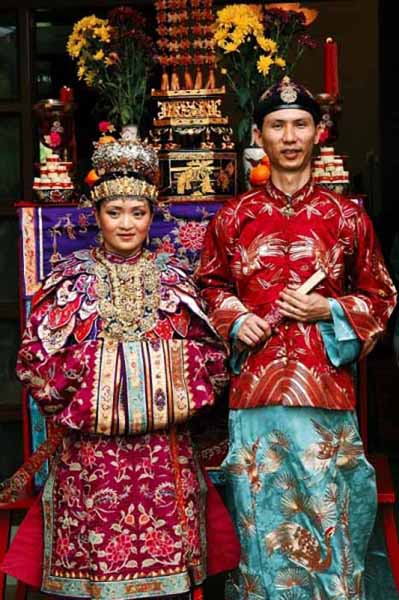
The wedding ceremony of the Peranakan is largely based on Chinese tradition, and is one of the most colorful wedding ceremonies in Malaysia and Singapore. At weddings, theDondang Sayang, a form of extempore rhyming song in Malay sung and danced by guests at the wedding party, was a highlight. Someone would begin a romantic theme which was carried on by others, each taking the floor in turn, dancing in slow gyrations as they sang. It required quick wit and repartee and often gave rise to laughter and applause when a particularly clever phrase was sung. The melodic accents of the Baba-Nonya and their particular turns of phrase lend to the charm of this performance.
(credits to http://nyonyaandbaba.blogspot.my/2009/07/marriage-of-baba-and-nyonya.html)
That's all guys. XOXO
Showing posts with label Peranakans. Show all posts
Sunday, April 24, 2016
Wedding of the Peranakans
Tuesday, April 19, 2016
Taboo's of the Peranakans family
Assalamualaikum :)
As what the topic of this entry, we will share with you on the taboos within the family of Baba Nyonya.
Mysterious Peranakan Taboos
Taboo is a prohibition resulting from social custom. It is also called “pantang-larang” in Baba Malay. We got the information of Peranakan taboos from a Baba at a restaurant in Malacca when he was having his lunch with his family, but he refused to take a picture with us. From him, we got to know that Peranakan taboos are almost the same as Chinese taboos. Here are some taboos that he mentioned:
Marriage taboos
1.Pregnant women are not allowed to attend any weddings and get involve in the preparations for the wedding ceremony.
2.A new born baby and the mother are also strictly prohibited to attend any weddings unless the baby’s “Full Moon” celebration is celebrated. Even the family members of the baby are not welcomed during the wedding as the groom and bride might think that they would bring bad luck to them.
3.Guests are not allowed to wear black or white attire while attending the weddings as these attires are meant for “sorrow occasion.”
Chinese New Year taboos
a. Sweeping is forbidden during the first three days of Chinese New Year as they believe that good luck would be swept away. They also believe that it is considered “suay” which is known as “unlucky” when the broom touches their feet during the floor sweeping.
b. Children are encouraged to stay up late during Chinese New Year eve as they believe this will help to prolong the life of their parents.
Funeral taboo
1.When one has just passed away, her/his family members are encouraged to cover their mirrors and reflecting surfaces as they believe that the death person would catch their soul to accompany it to the underworld.
Dining taboo
1.Sitting at the corner of the dining table is a big “no-no” as they believe that the table corner is like a sharp knife pointing at the person who is sitting there.
Picture Taking taboo
1.It is strictly forbidden for three person to take a photo together as they believe that the one who is standing in the middle would be the first to die.
Other taboos
1.Children are strictly not to be allowed to point at the full moon as they believe that the God of the moon would cut around the children’s ear.
It seems that they practice few taboos just like how the Chinese did.oopss! OF course they do, as they are a mix of Chinese family too.
(taken from http://9peranakanlayers.blogspot.my/2011/03/taboo-is-prohibition-resulting-from.html)
Alright, that's all for today guys. We'll update more in the next entry. Adios people.
As what the topic of this entry, we will share with you on the taboos within the family of Baba Nyonya.
Mysterious Peranakan Taboos
Taboo is a prohibition resulting from social custom. It is also called “pantang-larang” in Baba Malay. We got the information of Peranakan taboos from a Baba at a restaurant in Malacca when he was having his lunch with his family, but he refused to take a picture with us. From him, we got to know that Peranakan taboos are almost the same as Chinese taboos. Here are some taboos that he mentioned:
Marriage taboos
1.Pregnant women are not allowed to attend any weddings and get involve in the preparations for the wedding ceremony.
2.A new born baby and the mother are also strictly prohibited to attend any weddings unless the baby’s “Full Moon” celebration is celebrated. Even the family members of the baby are not welcomed during the wedding as the groom and bride might think that they would bring bad luck to them.
3.Guests are not allowed to wear black or white attire while attending the weddings as these attires are meant for “sorrow occasion.”
Chinese New Year taboos
a. Sweeping is forbidden during the first three days of Chinese New Year as they believe that good luck would be swept away. They also believe that it is considered “suay” which is known as “unlucky” when the broom touches their feet during the floor sweeping.
b. Children are encouraged to stay up late during Chinese New Year eve as they believe this will help to prolong the life of their parents.
Funeral taboo
1.When one has just passed away, her/his family members are encouraged to cover their mirrors and reflecting surfaces as they believe that the death person would catch their soul to accompany it to the underworld.
Dining taboo
1.Sitting at the corner of the dining table is a big “no-no” as they believe that the table corner is like a sharp knife pointing at the person who is sitting there.
Picture Taking taboo
1.It is strictly forbidden for three person to take a photo together as they believe that the one who is standing in the middle would be the first to die.
Other taboos
1.Children are strictly not to be allowed to point at the full moon as they believe that the God of the moon would cut around the children’s ear.
It seems that they practice few taboos just like how the Chinese did.
(taken from http://9peranakanlayers.blogspot.my/2011/03/taboo-is-prohibition-resulting-from.html)
Alright, that's all for today guys. We'll update more in the next entry. Adios people.
Sunday, April 17, 2016
Peranakan @ Baba Nyonya: 3
Assalamualaikum. Hi awesome people ;) we meet again in this entry on the Peranakans.
So today we gonna learn some of their language, okay? :)
The language of the Peranakans, Baba Malay (Bahasa Melayu Baba), is a creole dialect of the Malay Language (Bahasa Melayu), which contains many of the words from the Chinese Hokkien dialect. It is a dying language, and its contemporary use is mainly limited to members of the older generation. English has now replaced this as the main language spoken amongst the younger generation. Young Peranakans have lost many of their language, so there is normally a difference in vocabulary between the older and younger generations.
A glossary of some of the popular Baba Nyonya words:
Amek =Take
Apa khabair =How are you?
Apasair = Why?
Arimo = Tiger
Bak wan = Pork meatball
Bakol Sia = A red and black lacquered bamboo basket with cover
Besair = Big
Bibik = Form of address for an elderly lady
Bikin = Make
Bini = Wife
Brani = Brave
Bukan = No
Cha Kiak = Wooden Clogs
Changkir = Cup
Chap chai = Mixed vegetable stew
Chebok = To clean oneself up after defecating
Cherki = A traditional Nyonya card game
Chi wan = Bathroom
Gua = I/Me
Ia = Yes
Jantan = Man/male
Kachuak = Cockroach
Kalu = If
Kam Cheng = Porcelain jar with cover
Kam Siah = Thank you
Kasair = Rough
Kek khi = Annoyed/frustrated
Kek sim = Unhappy/heartbroken
Kepiting = Crab
Kopiah = Hat
Kui = Kneel
Kuping = Ear
Kus Semangat = An expression of surprise/mild shock
Laki = Husband
Lapair = Hungry
Lau Nuah = Drooling
Lawa = Stylish/good looking
Lecheh = Troublesome
Lemo = Lime
Lu = You
Loteng = Upstairs
Mo = Want
Ohng = Good luck
Omor = Age
Pasair = Market
Perot = Stomach
Pi = Go
Prompuan = Woman/female
Ramay = Well-attended/crowded (indicating many people)
Suay = Bad luck
Sumpet = Chopsticks
Temberang = Bluff
Tim = Double-boil
Tok Panjang = Long (dining) table
Tu = Cupboard
Ujan = Rain
Ulair = Snake
So now you can speak just like how the Peranakans speak too. happy learning new language ;)
So today we gonna learn some of their language, okay? :)
The language of the Peranakans, Baba Malay (Bahasa Melayu Baba), is a creole dialect of the Malay Language (Bahasa Melayu), which contains many of the words from the Chinese Hokkien dialect. It is a dying language, and its contemporary use is mainly limited to members of the older generation. English has now replaced this as the main language spoken amongst the younger generation. Young Peranakans have lost many of their language, so there is normally a difference in vocabulary between the older and younger generations.
A glossary of some of the popular Baba Nyonya words:
Amek =Take
Apa khabair =How are you?
Apasair = Why?
Arimo = Tiger
Bak wan = Pork meatball
Bakol Sia = A red and black lacquered bamboo basket with cover
Besair = Big
Bibik = Form of address for an elderly lady
Bikin = Make
Bini = Wife
Brani = Brave
Bukan = No
Cha Kiak = Wooden Clogs
Changkir = Cup
Chap chai = Mixed vegetable stew
Chebok = To clean oneself up after defecating
Cherki = A traditional Nyonya card game
Chi wan = Bathroom
Gua = I/Me
Ia = Yes
Jantan = Man/male
Kachuak = Cockroach
Kalu = If
Kam Cheng = Porcelain jar with cover
Kam Siah = Thank you
Kasair = Rough
Kek khi = Annoyed/frustrated
Kek sim = Unhappy/heartbroken
Kepiting = Crab
Kopiah = Hat
Kui = Kneel
Kuping = Ear
Kus Semangat = An expression of surprise/mild shock
Laki = Husband
Lapair = Hungry
Lau Nuah = Drooling
Lawa = Stylish/good looking
Lecheh = Troublesome
Lemo = Lime
Lu = You
Loteng = Upstairs
Mo = Want
Ohng = Good luck
Omor = Age
Pasair = Market
Perot = Stomach
Pi = Go
Prompuan = Woman/female
Ramay = Well-attended/crowded (indicating many people)
Suay = Bad luck
Sumpet = Chopsticks
Temberang = Bluff
Tim = Double-boil
Tok Panjang = Long (dining) table
Tu = Cupboard
Ujan = Rain
Ulair = Snake
So now you can speak just like how the Peranakans speak too. happy learning new language ;)
Tuesday, March 29, 2016
Peranakan @ Baba Nyonya: 2
Assalamualaikum and hi awesome people ;)
so let us continue on the Peranakans. Previous entry was on the history right? so in this entry we wanna focus on the dressing of the Baba Nyonya.
whenever we talks about Baba and Nyonya, one thing that will come out is their dressing which is 'kebaya'. Nyonya Kebaya is a unique traditional ethnic clothes worn by the Straits Settlement Chinese ladies who are known as nyonyas. The Baba and Nyonya, even though originally are ethnic Chinese, adopt the way of dressing, some cultural practices and also local food in their daily lives.
The main difference of nyonya kebaya from other kebayas is that, the material used for the top is sheer. The material can be gauze cotton, voile or georgette. Since the top is made out of translucent material, it is necessary to wear an inner cotton camisole which is called "anak baju". The top is embroidered with beautiful motifs with extra emphasize at the collar, the sleeves and the hem of the jacket. The motifs are usually hand-made. As with other craft, machine-made embroidery would not look as good as the hand-made ones. As for the sarong, batik from Java is used. Locally known as "batik Jawa", there are several cuts to choose from. The more shapely ladies would love to show off their lovely legs with a sarong with a slit in front. The slit would only show as they walk.
There are two basic styles of nyonya kebaya. The one with long jacket (known as kebaya labuh) and also another with the short jacket (kebaya pendek).
Kebaya labuh is usually worn by elderly ladies. The cut is straight, and the length comes down to the knees, sometimes almost to the calves. The material is still sheer, and anak baju is also needed. A set of brooches (usually a set of three) are used to secure the front of the jacket. A chiffon embroidered handkerchief is cleverly tucked at the collar completes the look.Kebaya pendek is much preferred by the younger nyonyas. The cut hugs the figure and the length of the jacket only reaches the hips. This costume shows off the shape of the women beautifully.
(the old picture of nyonya in kebaya pendek)
(modern kebaya pendek)
(kebaya labuh)
credit tohttp://www.penangheritagecity.com/nyonya-kebaya.html
So that's all for now guys. We'll updare more soon. Keep coming folks! ;)
XOXO
so let us continue on the Peranakans. Previous entry was on the history right? so in this entry we wanna focus on the dressing of the Baba Nyonya.
whenever we talks about Baba and Nyonya, one thing that will come out is their dressing which is 'kebaya'. Nyonya Kebaya is a unique traditional ethnic clothes worn by the Straits Settlement Chinese ladies who are known as nyonyas. The Baba and Nyonya, even though originally are ethnic Chinese, adopt the way of dressing, some cultural practices and also local food in their daily lives.
The main difference of nyonya kebaya from other kebayas is that, the material used for the top is sheer. The material can be gauze cotton, voile or georgette. Since the top is made out of translucent material, it is necessary to wear an inner cotton camisole which is called "anak baju". The top is embroidered with beautiful motifs with extra emphasize at the collar, the sleeves and the hem of the jacket. The motifs are usually hand-made. As with other craft, machine-made embroidery would not look as good as the hand-made ones. As for the sarong, batik from Java is used. Locally known as "batik Jawa", there are several cuts to choose from. The more shapely ladies would love to show off their lovely legs with a sarong with a slit in front. The slit would only show as they walk.
There are two basic styles of nyonya kebaya. The one with long jacket (known as kebaya labuh) and also another with the short jacket (kebaya pendek).
Kebaya labuh is usually worn by elderly ladies. The cut is straight, and the length comes down to the knees, sometimes almost to the calves. The material is still sheer, and anak baju is also needed. A set of brooches (usually a set of three) are used to secure the front of the jacket. A chiffon embroidered handkerchief is cleverly tucked at the collar completes the look.Kebaya pendek is much preferred by the younger nyonyas. The cut hugs the figure and the length of the jacket only reaches the hips. This costume shows off the shape of the women beautifully.
(the old picture of nyonya in kebaya pendek)
(modern kebaya pendek)
(kebaya labuh)
So that's all for now guys. We'll updare more soon. Keep coming folks! ;)
Labels:
Baba Nyonya,
kebaya labuh,
nyonya kebaya,
Peranakans
Sunday, March 27, 2016
Peranakan @ Baba Nyonya: 1
Assalamualaikum. Hi and welcome back to the Three Musketeers' blog: cultural weekly project. :)
Last entry we shared on Saudi Arabia aite? but in this entry we are not sharing on the same topic, as the post title is about Peranakan or known as Baba Nyonya. Enjoy reading and learning guys.. :)
"Peranakan", "Baba-Nyonya" and "Straits-born Chinese" (named after the Straits of Malacca/Straits Settlement under the British rule of Malaya) are terms used for the descendants of the early Chinese immigrants to the Nusantara region who inter-married with local folks. This region includes the British Straits Settlements of Malacca, Penang and Singapore and the Dutch-controlled island of Java.
The birth of Malaysia's & Singapore's unique Peranakan or BabaNyonya heritage dates back to the early 15th century when Melaka was ruled by a Malay sultanate kingdom in which during that time, it was also a prosperous and strategic trading port for herbs and spices. As a trading port for the region, Melaka had enjoyed very strong relations with the kingdom of China.
The word "Peranakan" is also commonly used to describe Indonesian Chinese. In both Malaysia and Indonesia local languages, "Peranakan” means descendant. "Baba" refers to the male descendants and "Nyonya" the female.
Because the early Peranakans inter-married with the local Malay population, most early Peranakans are tan in skin color, albeit in this modern day and age where the ancestry bloodline for many have been diluted, it may not necessary be so anymore.
Well, in the early 15th century, close relations with the kingdom of China was established during the reign of Parameswara (the founder of Melaka way before Malaya -now Malaysia- was formed). Great tributes were given during the visit by China's Admiral Cheng Ho (Zheng He) to Malacca. In return for such tributes, a princess of China called "Puteri Hang Li Po" ("Puteri" means Princess) was presented as a 'gift' to the ruling Sultan of Malacca, Sultan Mansur Shah circa 1459 AD (who was Parameswara prior to his throning) to forge closer trading ties. The Princess and her entourage of servants then settled in Bukit Cina (means "Chinese Hill") in Malacca. With the Princess having married the Sultan and later her entourage also followed suit by marrying local Malay folks, thus eventually emerged the beginning of this centuries-old culture called "Peranakan" or "Baba-Nyonya".
In addition, records also show that following the successful union of China and Malacca through the marriage of Sultan Mansur Shah and Princess Hang Li Po, more Chinese male and female immigrants had come to Malacca, leading to more inter-marriages and the continued development of this unique Peranakan heritage.
By the middle of the 20th century, most Peranakans were English educated as a result of British colonisation of Malaya (which included Singapore at that time). They filled jobs in civil service as they had embraced English culture and education openly. The interaction with the British also resulted in some Peranakans converting to Christianity, thereby they became influential under the British colonisation. The Peranakan communities were also known as the King's Chinese due to their perceived loyalty to the British Crown. The culture and heritage then developed further and flourished to Penang and Singapore as Malacca Peranakans were transferred to fill administrative and civil jobs at these places. At that time, Malacca, Penang and Singapore had been formed the British Straits Settlements.
old pic of Straits Settlements
(credits to http://nyonyapendekmelaka.blogspot.my/2009/07/peranakan-its-historical-beginning-and.html)
We'll update more on Peranakans in the other entry. see yaaaa!! :)

Last entry we shared on Saudi Arabia aite? but in this entry we are not sharing on the same topic, as the post title is about Peranakan or known as Baba Nyonya. Enjoy reading and learning guys.. :)
"Peranakan", "Baba-Nyonya" and "Straits-born Chinese" (named after the Straits of Malacca/Straits Settlement under the British rule of Malaya) are terms used for the descendants of the early Chinese immigrants to the Nusantara region who inter-married with local folks. This region includes the British Straits Settlements of Malacca, Penang and Singapore and the Dutch-controlled island of Java.
The birth of Malaysia's & Singapore's unique Peranakan or BabaNyonya heritage dates back to the early 15th century when Melaka was ruled by a Malay sultanate kingdom in which during that time, it was also a prosperous and strategic trading port for herbs and spices. As a trading port for the region, Melaka had enjoyed very strong relations with the kingdom of China.
The word "Peranakan" is also commonly used to describe Indonesian Chinese. In both Malaysia and Indonesia local languages, "Peranakan” means descendant. "Baba" refers to the male descendants and "Nyonya" the female.
Because the early Peranakans inter-married with the local Malay population, most early Peranakans are tan in skin color, albeit in this modern day and age where the ancestry bloodline for many have been diluted, it may not necessary be so anymore.
Well, in the early 15th century, close relations with the kingdom of China was established during the reign of Parameswara (the founder of Melaka way before Malaya -now Malaysia- was formed). Great tributes were given during the visit by China's Admiral Cheng Ho (Zheng He) to Malacca. In return for such tributes, a princess of China called "Puteri Hang Li Po" ("Puteri" means Princess) was presented as a 'gift' to the ruling Sultan of Malacca, Sultan Mansur Shah circa 1459 AD (who was Parameswara prior to his throning) to forge closer trading ties. The Princess and her entourage of servants then settled in Bukit Cina (means "Chinese Hill") in Malacca. With the Princess having married the Sultan and later her entourage also followed suit by marrying local Malay folks, thus eventually emerged the beginning of this centuries-old culture called "Peranakan" or "Baba-Nyonya".
In addition, records also show that following the successful union of China and Malacca through the marriage of Sultan Mansur Shah and Princess Hang Li Po, more Chinese male and female immigrants had come to Malacca, leading to more inter-marriages and the continued development of this unique Peranakan heritage.
By the middle of the 20th century, most Peranakans were English educated as a result of British colonisation of Malaya (which included Singapore at that time). They filled jobs in civil service as they had embraced English culture and education openly. The interaction with the British also resulted in some Peranakans converting to Christianity, thereby they became influential under the British colonisation. The Peranakan communities were also known as the King's Chinese due to their perceived loyalty to the British Crown. The culture and heritage then developed further and flourished to Penang and Singapore as Malacca Peranakans were transferred to fill administrative and civil jobs at these places. At that time, Malacca, Penang and Singapore had been formed the British Straits Settlements.
old pic of Straits Settlements
(credits to http://nyonyapendekmelaka.blogspot.my/2009/07/peranakan-its-historical-beginning-and.html)
We'll update more on Peranakans in the other entry. see yaaaa!! :)
Subscribe to:
Posts (Atom)


